A prenatal ultrasound reveals baby’s rare disease
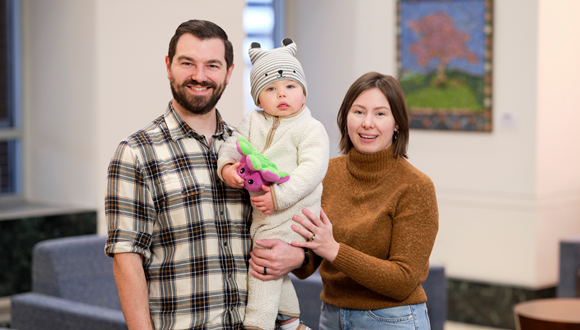
When Dana was pregnant with her first child, she was excited for the milestones of motherhood — her first perinatal visit, her first ultrasound image and hearing the baby’s heartbeat for the very first time.
But what Dana and her husband didn’t count on was the concerning news they received during her pregnancy. Their baby’s heart was growing on the opposite side of his chest — on the right side of his little body, rather than the left. It’s a rare condition known as dextrocardia, which affects one in 10,000 newborns — and can lead to serious lifelong health complications.
A diagnosis before baby’s birth
“The ultrasound showed that Michael’s umbilical cord had two vessels instead of three, which usually means there are other medical complications, too,” says Dana, who is a nurse practitioner at Atlantic Health.
Further tests revealed that Michael had only one functioning kidney. Then the echocardiogram confirmed his rare disease. His heart — and all his organs — were opposite of where they’re typically found.
Understanding a rare disease
“Everything inside Michael is flipped,” Dana says. “His body is a mirror image of ours. His heart is on the right. His liver is on the left. His spleen is on the right.”
Michael’s condition is known as situs inversus, a Latin medical term that means reversed position. It’s extremely rare, and often comes with congenital heart defects, respiratory disease, immune system challenges and spinal abnormalities — health complications that Dana and her husband hoped to rule out after the delivery.
A solid start to life
Michael was born in the Spring of 2024 and spent his first four days of life in the Neonatal Intensive Care Unit at Atlantic Health Morristown. During that short stay, he braved lots of testing: echocardiograms, X-rays, blood work and a full genetic workup facilitated by Atlantic Health geneticist Darius Adams, MD.
“I was grateful that we found out about the disease during my pregnancy,” says Dana. “It gave us a chance to understand Michael’s condition and build the right care team.”
That care team included pediatric urologist Gina Cambareri, MD, pediatric nephrologist Howard Corey, MD (now retired), pediatric cardiologist Jeffrey Dayton, MD, neonatologist Karen Gluck, MD, and other experts at Atlantic Health’s Hersch Fetal Center.
Testing for related medical conditions
During the first few days of Michael’s life, doctors ruled out some serious complications associated with situs inversus.
“Even though Michael’s heart is reversed, it’s structurally normal so he didn’t need heart surgery,” says Dana. “Michael was also cleared from a related lung disease known as primary ciliary dyskinesia (PCD), which was another huge weight lifted off our shoulders.”
Managing the unknowns
Michael does face some health challenges, though. His spinal abnormality causes a slight head tilt and may eventually require surgery. Doctors are also monitoring his spleen for abnormal function that could affect his immune system.
“We feel lucky to be connected to so many Atlantic Health specialists who work together and monitor Michael so closely,” says Dana. “In his first year of life, he had 68 doctor’s visits with 14 different specialists. Now, it’s become routine, with fewer visits and fewer worries.”
Finding strength and purpose
Initially, Dana searched for a support group but found nothing. So, she started her own not-for-profit to help families affected by situs inversus.
“We’re helping parents navigate this rare and complex disease,” says Dana, who presented at the National Institutes of Health and on Capitol Hill for Rare Disease Week 2026.
A happy, healthy toddler
Now, at almost two years old, Dana’s son Michael is a joyful and energetic toddler who’s exceeding his developmental milestones. “He’s ahead of the curve,” she says. “He never sits still, except when he’s watching Bob Ross paint. In fact, his first two-word phrase was ‘Bob Ross.’”
And when Dana teaches Michael about his body, she points out that his heart lives on the right side of his chest, not the left. “I tell Michael that since his heart is on the opposite side, when I hug him, our hearts actually touch — and that’s what makes our hugs so extra special.”
Related news articles


