Thinking about chiropractic care? Here’s how it can help
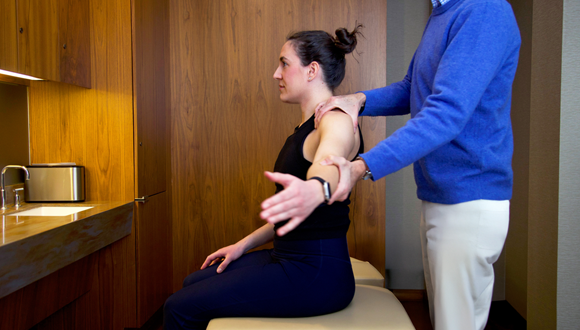
If you’re reading this on your phone or laptop, chances are your shoulders are rounded and your neck is tilting forward. It may not seem like a big deal, but for many, sitting in this position day after day can lead to muscle imbalance—and pain.
In fact, today’s screen-heavy lifestyle is one of the biggest reasons people are turning to chiropractic care, according to Jeffrey Larkin, DC, a chiropractor at Atlantic Health Chambers Center for Well-Being.
More than “cracking backs”
“Many people live in chronic pain and don’t need to,” says Dr. Larkin. “When we can identify the driver behind a person’s pain and address it at its root cause, symptoms naturally begin to improve.”
Dr. Larkin specializes in instrument-assisted soft tissue manipulation (IASTM) and active release technique (ART). These are different than a typical spine or neck adjustment, which people often associate with chiropractic care. Instead, IASTM and ART are therapies that release tight muscles, scar tissue and restricted movement—beyond the back and spine.
“A large portion of my work involves soft tissue work,” he says. “When I can get tissue to glide the way it’s supposed to, many patients leave here noticing improved range of motion and a sense of relief.”
Treating pain at the source
Whether they’re recreational athletes or triathletes, young adults in their 20s and 30s are choosing chiropractic care to treat strains and injuries. Adults in their 50s and 60s also turn to it for joint stiffness and when old injuries begin to resurface.
Here are some common conditions chiropractors treat:
- Repetitive strain injuries in the neck
- Carpel tunnel wrist strains
- Shoulder dysfunction
- Arthritis-related joint stiffness
- Iliotibial band syndrome (ITBS)
- Plantar fasciitis
- Frozen shoulder
- Sports and overuse injuries
“When we apply manual pressure to tissue limitations, then guide patients through specific movements, the tissue starts functioning properly again,” Dr. Larkin says. “Our goal isn’t just pain relief — it’s restoring healthy movement to reduce the risk of recurrence.”
A whole-body approach
According to Dr. Larkin, the source of the pain isn’t always where you feel it. Carpal tunnel symptoms may stem from tight tissue compressing a nerve. Low back pain could be from tight hips. Shoulder pain can be a muscle imbalance. And the all-too-common “tech neck” is often about posture.
Dr. Larkin uses golfers with low back pain as a good example. “Their issue isn’t always the spine — it is usually tight hips that limit rotation during the swing, which strains their lower back.”
When to consider chiropractic care
An initial consultation typically includes a hands-on assessment and testing your movement and range of motion. To decide if chiropractic care is right for you, start by answering a few simple questions:
- Do you have ongoing pain that has persisted for weeks or months?
- Does movement feel strained, restricted, uneven or just “off?”
- Are you relying on medication but not seeing improvement?
- Would you consider a hands-on, nonsurgical, movement-focused approach?
“Our goal is to empower patients,” says Dr. Larkin. “We get you moving better. We’ll give you appropriate exercises so you can maintain your progress. Once your movement normalizes and symptoms resolve, you’ll head home with a personalized plan.”
Related news articles


